The Thinking Tax: Why Your AI Bill Is About to Explode
Four years ago, "AI" meant a chatbot that could write you a limerick and occasionally lie about who won the 1998 World Cup. Today it writes production code, reads X-rays, runs multi-hour agentic tasks unsupervised, and drafts this sentence better than I can. That is a staggering four years. Nobody in the field will tell you they saw the pace coming.
But I want to talk about the part of the story that doesn't make the launch-day headlines: the bill. Because the last four years weren't just an explosion in capability — they were an explosion in cost, and most of us haven't felt it yet. That's about to change.
We've been drinking at an open bar
Here's the uncomfortable truth. The price you pay for frontier AI today is not the price it costs to run.
Analysts reckon current API pricing is subsidised to the tune of a 10x to 20x discount versus what standalone deployment actually costs — the providers have been eating the difference to buy market share. That works right up until it doesn't. Epoch projects that the big hyperscalers' capital spending will overtake their operating cash flow around Q3 2026 — the moment combined free cash flow hits zero and the pressure flips from "grab users" to "stop the bleeding." The advice being handed to enterprises right now is blunt: budget for 30–50% price increases over the next 18 months. (Arize, Everpure)
And it's already started. GPT-5.5 launched at $5/$30 per million input/output tokens — double its predecessor. Opus 4.7 didn't raise its sticker price, but its new tokenizer quietly produces up to 35% more tokens per prompt, which is a price rise wearing a disguise. The two-year trend of models getting cheaper every quarter reversed in 2026. (pricepertoken)
The models started thinking — and thinking isn't free
There's a second, sneakier cost driver, and it's baked into the very thing that makes modern models so good: reasoning.
The best models today don't answer — they deliberate. Before they show you 200 words, they can burn 10,000 to 30,000 tokens of internal "thinking" you never see but absolutely pay for. Reasoning models generate 5x to 50x more tokens per query than the old fast models. The same question that costs $0.02 on a quick model can cost $0.60 on a reasoning one — a 30x swing, entirely from invisible deliberation. (aioutlooks, newline)
It gets weirder. Researchers have documented a "price reversal phenomenon": in nearly a third of model comparisons, the model with the lower sticker price ends up with the higher total bill, because it thinks more to get there. Cheaper per token, more expensive per answer. The headline number lies to you now. (arxiv)
So we have a scissor closing on us: subsidies ending on one blade, and models that consume 100x more tokens internally than they emit on the other. The per-token price and the tokens-per-task are climbing at the same time.
And someone has to keep the lights on — literally
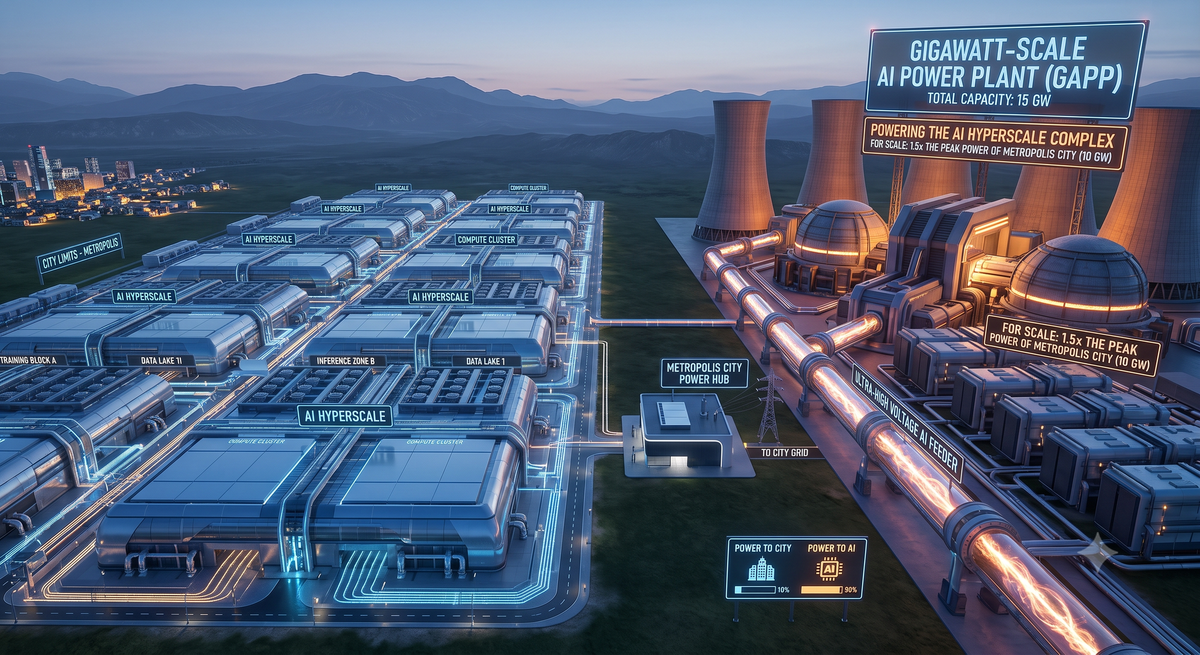
Here's the part that still makes me do a double-take. We have reached the point where a data centre needs its own power station.
Not a bigger utility bill. Its own generation. A single hyperscale training cluster can pull 100 megawatts — enough to run a small city. Grid interconnection queues are backed up with 2,600 GW of requests and five-year waits, so the labs simply stopped waiting for the grid. As of mid-2026, every major hyperscaler has signed at least one nuclear deal — 13 projects, 9.8+ GW committed. Meta locked up 6.6 GW of nuclear in January. Microsoft is restarting Three Mile Island. AWS bought 1.92 GW straight off the Susquehanna plant. And where nuclear is too slow, they're co-locating gas plants — Chevron is in talks to build generation dedicated to a single Microsoft data centre in Texas. (SMRIntel, DatacenterKnowledge)
Sit with that. The cost of a token now includes a share of a reactor refurbishment. When people say AI is "just software," show them the power purchase agreement.
What it all adds up to: the $10 developer won't stay $10
Now connect the dots, because this is where it lands for you and me.
AI is already reshaping the workforce — teams are shipping more with fewer people, and productivity per engineer is genuinely up. That's real, and it's not going away. But the story everyone tells is only half told. The narrative is "AI makes labour cheap." The reality is "AI is temporarily making elite labour cheap, on someone else's dime."
Think about what you're actually renting today. For $20 a month — a subscription that, on a heavy day, can burn $18–25 of inference on your behalf — you get something close to a very good junior-to-mid developer who never sleeps. That is absurd. That is an open-bar price for a genius on tap.
It won't last, because the value and the price are miles apart. A very good human developer costs a company somewhere north of $10,000 a month, fully loaded. Right now AI is delivering a large slice of that value for the price of two lunches. As the subsidies end, as the reasoning tokens pile up, and as the power stations get amortised into the bill, the price of "a very good developer on tap" is going to march away from $10 and toward what a very good developer is actually worth — hundreds, then thousands a month. Any serious software development that is generating code every day can require $600+ per month, depending on the model you are using.
That's not a doom prediction. It's just economics catching up to reality. The productivity is real, the workforce shift is real — and the true cost of the tool is real, too. It's been sitting on a shelf marked "subsidised," and it's coming down.
Who will pay the bill first ?
The big corporations. Right now , big corps "hire" top notch "developers" - Frontier models that know how to code. The main difference is that these companies don't just ask ChatGPT or Claude "Build me a web site that sells clothes". They expect and ask heavy duty tasks. Refactor my core engine, write unit tests for my 100K line of complicated/spaghetti code, build my enterprise software from scratch (because it actually sucks), write this new feature for my customer (which my developers never had the time to do - 1 year vs 1 month).
Once AI writes the code , AI will maintain it. And when you deliver features and core optimizations in weeks , your customers and your product management will want more and faster. This outpaces any human capability to maintain, verify, design and ship new code at this pace and sophistication.
Bottom line, big corps will end up paying $1000s to maintain their new status. And you cant just get out of it. Simple because what took a company millions of dollars to build , AI can rebuild it in a few months. This also changes the definition of Intellectual Property and Innovation - but thats for the another post to unfold.
The hook
Remember the good old days when google was gathering all the searches and thoughts of the world's population ? Social media platforms capturing privacy sensitive data ? Some tried to fight it, today most are actually willing to pay to put their habits, thoughts, likes, dislikes, names, birthdays ...
The digital gold is data. AI needs more data (not just a nuclear plant). The search has now become AI chat. Social media is AI , creative works is AI. The more we use it , at some point we wont be able to live without it. You dont google it anymore , you AI it (and to be honest it does it better and saves time - But be vigilant).
So what do you do about it?
Don't panic — plan. Three moves:
- Measure cost per task, not cost per token. The sticker price is now the least reliable number in your budget. Watch the thinking.
- Right-size the model to the job. Not every task needs the reasoning flagship burning 30K tokens to decide. A cheaper model — or one you run yourself — often wins on total cost.
- Lock in the value while it's cheap. We are, right now, living through a window where world-class capability is priced like a hobby. Use it. Build the skills, ship the products, learn the craft — before the bill catches up to the brilliance.
- Trust is not inherent. Learn how to verify what AI does and decide yourself what makes sense. Use multiple models or if you are an old timer try to educate yourself first. Steer the model with design first, code next.
The last four years gave us a genius for ten bucks. The next four will tell us what that genius really costs.
Keep building.