The Frontier Grows a Bouncer — So Learn to Drive Anything
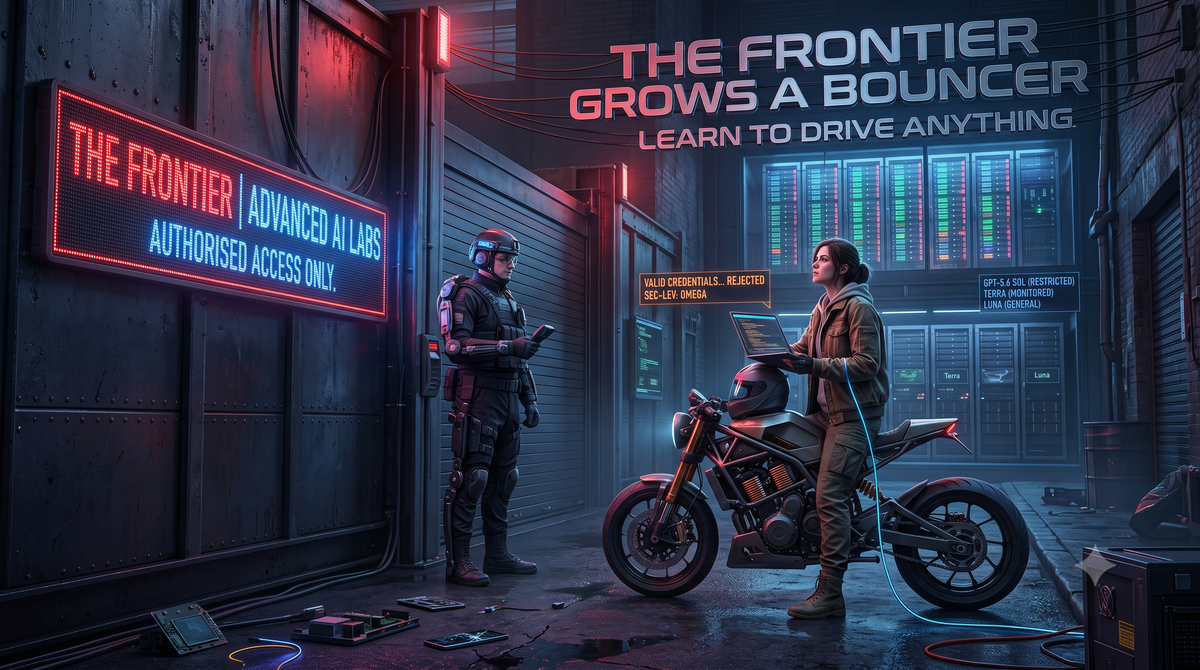
The Frontier Grows a Bouncer — So Learn to Drive Anything
A funny thing happened on the way to the AI singularity: the best models started asking for ID at the door.
If you only skim the headlines, 2026 looks like business as usual — new model, bigger number, another benchmark record. Look a little closer and something has changed. The most capable systems being built right now are not shipping to you and me. They are shipping to a short list of vetted organisations, and the list is being drawn up in Washington or Beijing or wherever the AI lab is subject to operating, not in a product roadmap meeting.
I want to talk plainly about what that means, because I think a lot of engineers are looking at the wrong scoreboard.
What actually happened these last few weeks
Two events tell the whole story.
First, OpenAI previewed the GPT-5.6 family — Sol at the top, then Terra, then the cheap-and-fast Luna. Sol is, by their own numbers, state of the art on multi-step command-line coding and neck-and-neck with Anthropic's best on exploit-finding. And who can use it? Roughly twenty organisations the U.S. government approved. Not twenty thousand. Twenty. OpenAI itself said it previewed the models to the government first and, at the government's request, held the launch to a tiny circle. To their credit, they also said out loud that they don't want this to become the default. (OpenAI, VentureBeat)
Second, Anthropic. On 9 June they launched Claude Fable 5 and Mythos 5. Three days later, an export-control directive landed and they had to pull both models for every customer on the planet — the stated trigger was a jailbreak someone had found. Access came back only in stages: Mythos to about a hundred trusted U.S. orgs on the 26th, then Fable restored globally on 1 July after Commerce withdrew the license requirement. (Anthropic, CNBC)
Read those two stories together and the shape of the future gets hard to miss. The frontier is no longer just expensive — it is gated. A model can now be switched off for the entire world by a letter. And the safeguards that used to be reserved for the scariest flagship are now baked into even the cheap tier: GPT-5.6 Luna ships with the same biology, chemistry and cyber classifiers as its big siblings, which means anyone doing legitimate high-volume work — verifying vulnerabilities in your own codebase, say — can now hit refusals, paused output, and account reviews on the budget model.
The uncomfortable projection
Extrapolate honestly. The models keep getting more capable. The most capable ones keep getting more sensitive. And "sensitive" is increasingly decided by governments, not by an EULA.
So the truly frontier stuff — the systems that can autonomously chain an exploit end to end, or hand a novice real bioengineering knowledge — those are going to live behind a velvet rope. Available to a few labs, a few agencies, a few blessed enterprises. That is not a conspiracy theory; it is the literal policy that shipped in June, complete with an executive order and a "repeatable process for future releases."
If your entire plan as an engineer is "wait for the best model and call its API," you have handed the keys to your career to a permissions list you will never be on.
The good news, and it's genuinely good
Here is where I get optimistic, because this is the part the hype cycle buries.
The gap between the locked frontier and the open field has never been more crossable by skill. A 4-billion-parameter open model today does things last year's 70B could barely manage. Teams are quietly discovering that a fifteen-cents-per-million-token model delivers ninety percent of the value at five percent of the cost. Small, open models graduated this year from "interesting research direction" to "default deployment choice." (BentoML, Analytics Insight)
And you don't even have to pick just one. Sakana's Fugu models orchestrate a pool of other models task by task — hand a job to the right worker at the right moment — and land near the top of the benchmarks without being chained to any single provider. As they put it, if you control the pool, you can turn models on and off for cost, for data sensitivity, for whatever you need. Even Microsoft went and trained its own reasoning model from scratch rather than renting someone else's brain. The whole industry is quietly hedging against exactly the dependency that just bit everyone in June.
Notice what all of these have in common: the edge is in the engineering, not the model.
I've lived this argument before
I spent years pulling malware apart (and other stuff). And the thing nobody tells you is that the best work in that field almost never came from the most expensive tool. One of the most satisfying wins I ever wrote up was speeding up a memory scan by 91% — not with a bigger server, but by moving the filesystem onto a RAM-backed device. Same free tools. Same commodity box. The gain was entirely in understanding the system well enough to know where the real bottleneck was.
Andrew Ng frames the same idea more elegantly: if you want to learn to drive, you need a car to practise in — but the skill is driving, not the car. After the lesson, what you drive is up to you.
That is the whole game. The car — the specific model — will keep changing, and some of the nicest cars are about to be parked in a government garage. The driving is yours to keep.
So what do you actually do about it?
Don't mourn the frontier. Learn the craft that makes any engine sing. Concretely:
- Get genuinely good with a small open model on your own hardware. Pick one, run it locally, and push it until you know its real limits — not the benchmark's.
- Master the fundamentals that transfer: evals, error analysis, agentic workflows, guardrails, prompt design. None of these care which model you point them at.
- Learn orchestration. The Fugu lesson is that a smart harness over cheaper models can rival a single flagship. Being the person who builds the harness is a better bet than being the person waiting for API access.
- Own your stack where it matters. If your data is sensitive or your uptime can't depend on a compliance letter, a model you can actually hold is worth more than a smarter one you can be cut off from.
The frontier will always be a few steps ahead, and increasingly it will be roped off. Fine. Let the few have the shiniest car. The rest of us are going to get very good at driving — and by the time the rope comes down, we'll be the ones who actually know how to move.
Keep building.